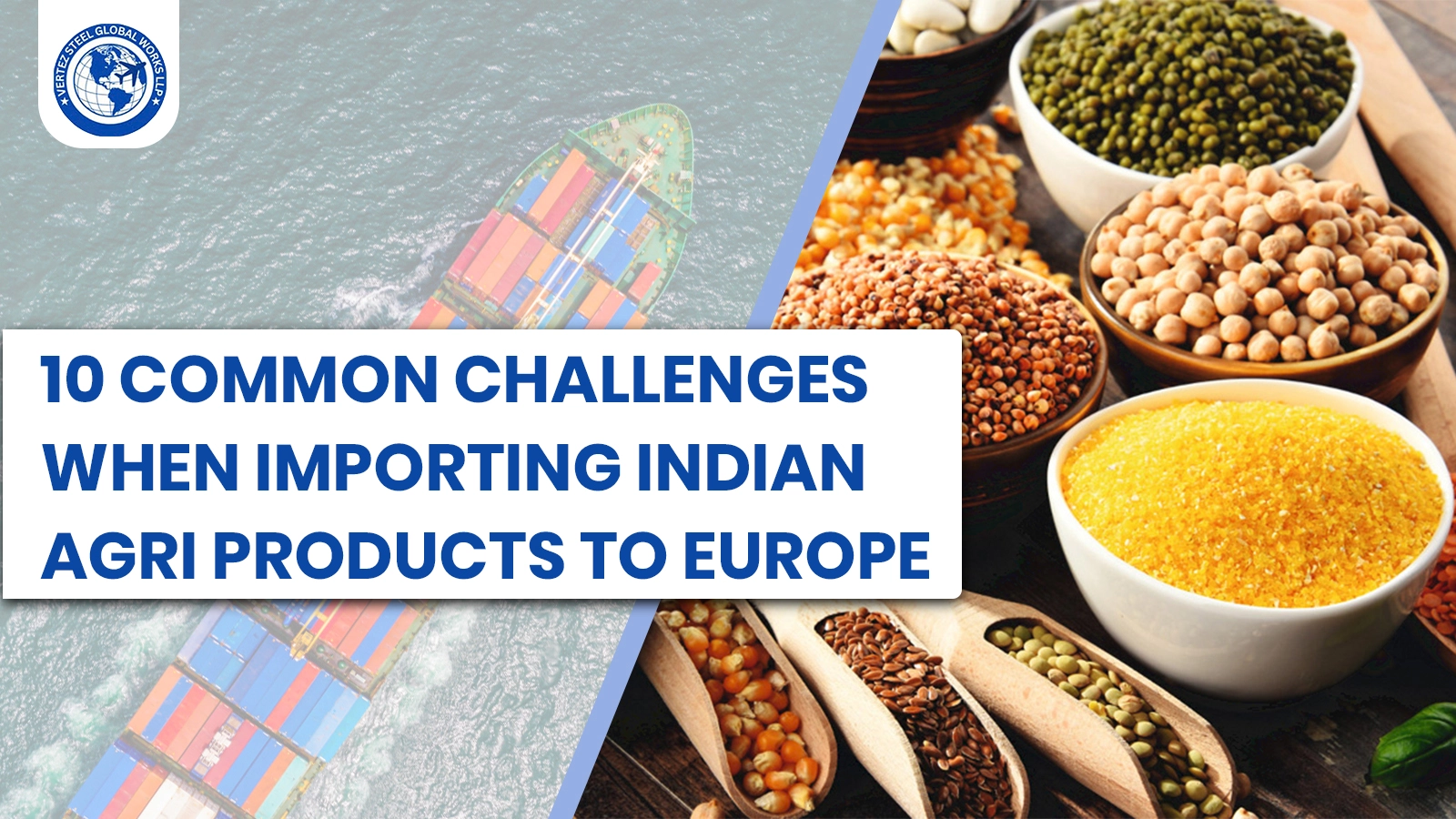
10 Common Challenges When Importing Indian Agri Products to Europe
Introduction
Setting the Context for Indian Agricultural Exports to Europe
The European Union stands as one of the world’s most lucrative—but uncompromising—markets for agricultural trade. With over €160 billion in annual agricultural imports, the EU represents immense opportunity for global suppliers. Yet despite India being among the world’s largest producers of rice, spices, pulses, fruits, and oilseeds, Indian agricultural exports account for less than 2% of total EU agri imports.
This disconnect is not driven by lack of demand. European buyers actively seek diversified sourcing to manage food security risks. The challenge lies in the regulatory density, enforcement rigor, and compliance expectations that define the European agri-import ecosystem.
For businesses looking to import agricultural products from India—or curate a viable import agricultural products list—Europe demands far more than competitive pricing or production scale. It requires precision, preparedness, and systemic compliance across the value chain.
This article breaks down the 10 most common challenges when importing Indian agri products into Europe, explaining where exporters face friction, why these issues persist, and how they compound commercially if left unaddressed.
Understanding the EU Agri-Import Landscape
Why Europe Is a High-Compliance, High-Risk Market
The EU’s agri-import regime is shaped by three dominant forces: consumer safety, environmental protection, and political accountability. Unlike many markets that align closely with Codex Alimentarius or WTO benchmarks, the EU routinely applies standards that go significantly beyond global norms.
A critical distinction defines success in Europe:
- Market access determines whether a product is legally allowed to enter.
- Market survival determines whether it can continue entering without escalating scrutiny.
In the EU, survival is harder—and far more valuable.
1. Stringent Sanitary and Phytosanitary (SPS) Standards
Why SPS Compliance Is the Biggest Barrier for Indian Exporters
The EU enforces some of the world’s most rigorous SPS measures to protect human, animal, and plant health. These standards frequently exceed international benchmarks, leading to high rejection rates for Indian consignments due to pesticide residues, microbial contamination, or pest infestations.
Indian mango exports, for instance, have faced bans and interceptions due to Bactrocera dorsalis, requiring hot water treatments that often damage delicate varieties and reduce shelf life. Similarly, basmati rice exports struggle with aflatoxin contamination and residues of pesticides like tricyclazole—substances whose maximum residue limits (MRLs) have been repeatedly lowered by the EU.
The commercial impact is severe:
- Up to 50% physical inspection rates for certain categories like shrimp
- Detentions, destructions, and long-term inspection escalation
Exporters who adapt invest in farm-level traceability systems, adopt Good Agricultural Practices (GAP), and push for mutual recognition agreements (MRAs) to reduce dual testing burdens.
2. Food Safety Regulations and Quality Controls
Navigating the EU’s Zero-Risk Food Safety Regime
EU food safety laws impose strict controls on contaminants, additives, and chemical residues—often misaligned with India’s smallholder-dominated farming systems.
High-risk categories such as spices, peanuts, and marine products are routinely flagged under the Rapid Alert System for Food and Feed (RASFF). Indian groundnuts alone have triggered over 170 RASFF alerts since 2004, primarily due to aflatoxins caused by improper drying and storage.
These alerts extend damage beyond individual shipments:
- Heightened future inspections
- Increased insurance premiums
- Erosion of buyer confidence
Exporters mitigate this by strengthening cold-chain infrastructure, adopting bio-inputs, and conducting continuous residue monitoring—transforming compliance into a quality differentiator rather than a cost center.
3. Certification Requirements
When Documentation Becomes a Trade Barrier
EU-required certifications—health, phytosanitary, organic, and product-specific—demand extensive documentation, audits, and procedural alignment.
India’s dairy sector remains locked out due to non-recognition of FMD-free status, while marine exporters face repeated pre-export testing cycles. Without MRAs, Indian certifications often require revalidation in EU-approved labs, costing ₹8,000–₹40,000 per test.
Strategic exporters invest in:
- Farmer training
- Digital traceability
- Long-term certification equivalence through FTAs
4. Labeling and Packaging Standards
Compliance Beyond the Product Itself
EU regulations mandate detailed labeling covering:
- Nutritional values
- Allergens
- Country of origin
- Verifiable environmental claims
Packaging adds another layer, with bans on certain plastics and recyclability mandates. Mislabeling, weak seals, or misleading sustainability claims routinely trigger rejections—especially for processed foods and spices.
Those who adapt leverage eco-friendly packaging and multilingual compliance to align with Europe’s transparency-driven consumer culture.
5. Technical Barriers to Trade (TBT)
When Standards Become Gatekeepers
Technical Barriers to Trade regulate how products are produced, processed, and verified. For Indian agri exporters, these include:
- Mandatory HACCP and ISO certifications
- Pest risk analyses
- Post-harvest treatment protocols
Eggplant exports, for example, have faced restrictions due to lepidopteran pest risks. TBTs disproportionately affect smaller exporters lacking technical infrastructure.
Mitigation requires coordinated R&D, certification subsidies, and structured challenges to unjustified barriers through WTO channels.
6. Customs Procedures and Documentation Challenges
Administrative Friction at EU Borders
EU customs clearance depends on flawless documentation:
- Proof of origin
- Compliance certificates
- Electronic declarations
Indian exporters frequently face delays due to manual errors, system incompatibilities, or unclear domestic licensing procedures. For perishables, delays translate directly into demurrage costs and spoilage losses.
Digital documentation and training on the EU Registered Exporter (REX) system are critical to reducing friction.
7. High Tariffs on Sensitive Agricultural Products
Market Access Doesn’t Always Mean Market Advantage
Even under the EU–India FTA framework, sensitive products like rice, dairy, poultry, and fruits remain protected. The suspension of GSP benefits has further tightened margins for products like basmati rice and mangoes.
Exporters increasingly pivot toward value-added processing and niche ethnic segments to offset tariff exposure while lobbying for phased liberalization.
8. Environmental and Sustainability Compliance
The Rising Cost of Green Trade
The EU’s sustainability push includes carbon disclosure, ethical sourcing, and deforestation-free supply chains. Mechanisms like CBAM, though indirect for agriculture, influence embedded emissions across agri value chains.
Analysts warn of up to 10% sectoral decline without adaptation. Exporters respond by adopting low-carbon farming, sustainability certifications, and EU-backed technology transfers.
9. Market Access Restrictions
When Policy and Politics Limit Trade
Beyond tariffs and standards, explicit market access restrictions continue to constrain Indian agri exports. Quotas, exclusions, and bans affect products like dairy and poultry due to hygiene, traceability, or political sensitivities.
FTA carve-outs protect EU farmers but cap Indian diversification opportunities. Overcoming this requires:
- Targeting underserved niches
- Joint ventures for local compliance
- Data-backed advocacy through WTO platforms
10. Complex Sampling and Testing Procedures
The Hidden Cost of Compliance
EU testing protocols are both extensive and dynamic. Grapes are screened for 40+ residues, while shrimp inspection rates have climbed to 50% following historical violations.
The financial strain is significant, especially for small exporters. Best practices include:
- Pre-shipment testing
- Lab harmonization
- Real-time quality monitoring
Strategic Takeaways for Indian Agri Exporters
Turning Compliance into Competitive Advantage
In Europe, preparedness consistently outperforms price. The most resilient exporters adopt preventive compliance models, integrate traceability from farm to port, and collaborate closely with logistics and regulatory experts.
Frequently Asked Questions
What are the biggest risks when importing agricultural products from India to Europe?
SPS non-compliance, food safety alerts, and certification failures.
Which Indian agri products face the most EU rejections?
Spices, rice, peanuts, shrimp, and select fruits.
Are EU SPS standards stricter than Codex?
Yes—often significantly.
Does the EU–India FTA remove all barriers?
No. Sensitive agri products remain protected.
At The End
Preparing for Europe Is Not Optional—It’s Strategic
The European agri market rewards exporters who treat compliance as strategic infrastructure, not a regulatory afterthought. Every inspection, audit, and alert acts as a filter—separating transactional suppliers from long-term partners.
For businesses planning to import agricultural products into Europe or refine their import agricultural products list, success depends on orchestration across sourcing, documentation, quality control, and logistics.
This is where experienced, multi-vertical export partners such as Vertez Steel Global quietly add value—not by selling, but by absorbing complexity. Through agile sourcing, transparent processes, and end-to-end export execution, they enable importers to focus on growth while compliance runs in the background.
In the EU, preparation decides profitability. Those who plan for Europe don’t just enter the market—they stay there.