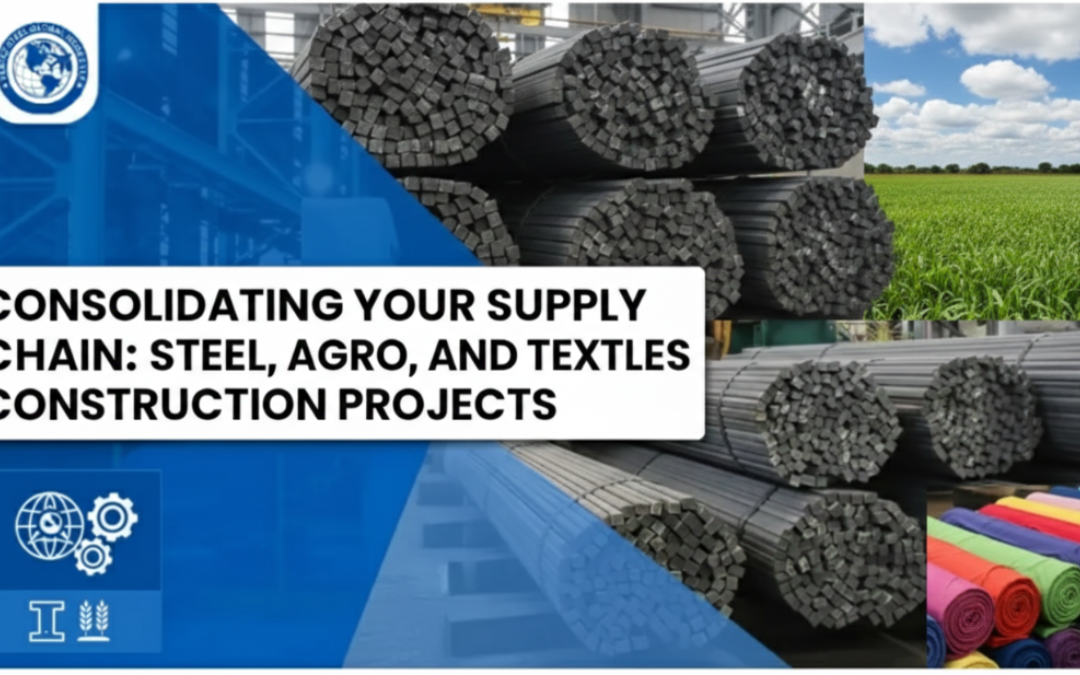
Consolidating Your Supply Chain: Steel, Agro, and Textiles
If you are planning bulk sourcing from India in 2026, you already know global trade is more crowded and competitive than ever. Freight prices change quickly. Ports are busy. Buyers expect faster delivery and stable pricing.
Because of this, bulk sourcing from India cannot be taken lightly. If you source steel, agro, and textiles separately without coordination, your costs increase and delays become common.
So how do smart importers stay profitable in 2026?
They consolidate their supply chain.
In this guide, you will understand the real problems buyers face, see why consolidation works, review a clear comparison example, learn how the process works step by step, and get answers to common buyer questions.
Let’s simplify everything.
The Real Issues Importers Face
Here are the most common challenges:
1. Rising Freight Costs
Ocean freight rates have seen fluctuations of 15–25% year-on-year in major trade lanes.
2. Port Congestion
Busy ports can delay containers by 5–14 days during peak seasons.
3. Scattered Documentation
Steel, agro, and textile exports require different certificates and compliance papers.
4. Multiple Vendor Misalignment
Production timelines rarely match.
5. Higher Inventory Costs
Warehousing costs in Europe and the UK have increased steadily due to storage demand.
When you manage separate suppliers, these issues multiply.
That is why structured bulk purchasing from Indian vendors is becoming essential.
What Is Supply Chain Consolidation?
Supply chain consolidation means:
Combining multiple product categories under one coordinated export system.
Instead of:
- Steel supplier A
- Rice exporter B
- Textile factory C
You work with one multi-product export partner who manages everything together.
This system is growing rapidly under organized India's many export models.
Before vs After: Clear Difference
Let’s compare.
Before Consolidation
- 3 suppliers
- 3 contracts
- 3 freight bookings
- 3 documentation processes
- 3 port handling charges
- 3 separate communication chains
Result:
- Higher cost
- Delays
- Confusion
- Cash flow pressure
After Consolidation
- 1 export coordinator
- Aligned production schedule
- Shared freight cost
- Centralized documentation
- Fewer containers
Result:
- 8–15% logistics savings (average estimate for consolidated shipments)
- Faster coordination
- Better visibility
- Lower operational stress
This is the advantage of structured multi-exports for India.
Why Consolidation Works
Industry shipping data across major trade lanes shows:
- Container utilization can drop below 70% when shipments are fragmented
- Logistics handling charges increase 8–15% with multiple dispatch cycles
- Documentation duplication adds administrative overhead
When structured planning is applied:
- Container utilization improves
- Freight negotiation becomes stronger
- Clearance timelines become predictable
This is the strength of coordinated bulk sourcing from Indian models in 2026.
Steel Sourcing in 2026: Why Precision Matters
Steel imports require:
- Mill test certificates
- Correct grades
- Thickness verification
- Country of origin documents
A single documentation error can delay customs clearance.
Common Steel Problems
- Mismatched specifications
- Missing certificates
- Late dispatch
- Damage due to poor packing
With a multi-product export partner, documentation is checked before dispatch, and production timelines are aligned with other goods.
Agro Exports: Data & Risk
India exports millions of tons of rice and spices annually. Agro exports require:
- Phytosanitary certificate
- Fumigation certificate
- Moisture testing
Inspection delays can push shipments back by 1–2 weeks during peak season.
Under structured bulk sourcing from India, inspection scheduling is planned early, reducing port delays.
Textile Imports: Speed Is Everything
Retail demand cycles are shorter than before.
If textile shipments miss season deadlines:
- Products may need discounting
- Retailers may cancel orders
Common textile issues:
- Label mistakes
- Size inconsistencies
- Packaging errors
Professional multi-export systems in India supervise production before consolidation, reducing return risks.
How Consolidation Actually Works
Let’s break it down clearly.
Step 1: Volume Planning
You forecast steel, agro, and textile demand for 3–6 months.
Step 2: Production Alignment
Timelines are coordinated across factories.
Step 3: Documentation Prepared Early
Export documents are verified before dispatch.
Step 4: Container Optimization
Goods are loaded strategically to reduce unused space.
Step 5: Unified Communication
You work with one multi-product export partner, not five separate vendors.
This is how modern integrated Indian exports operate.
Real 2026 Case Snapshot
A mid-sized European importer sourcing:
- Steel pipes
- Basmati rice
- Cotton fabric
Before coordination:
- 4 containers dispatched separately
- 2 delayed shipments
- 12% logistics overhead increase
After structured consolidation:
- 2 optimized containers
- Unified documentation
- Predictable delivery window
- 10–15% freight efficiency improvement
The biggest gain was not just cost.
It was stable.
Final Thoughts:
2026 is not a year where you can afford scattered buying or last-minute shipping decisions. Fragmented sourcing increases cost. Unplanned shipments create delays. Poor coordination slowly reduces your margins.
But when your procurement is structured, everything changes. You gain better control over timelines, clearer visibility on costs, and stronger coordination between steel, agro, and textile shipments. That control turns into predictability. And predictability turns into profit.
Managing bulk sourcing from India through an experienced partner like Vertez Steel Global Works LLP helps you reduce risk, align production, optimize container space, and protect your margins in a competitive global market.
In 2026, your advantage is not just about what you buy. It is about how efficiently you move it.
If you are planning your next import cycle, this is the right time to review your sourcing strategy. Connect with Vertez Steel Global Works LLP to explore a more organized, consolidated approach to your steel, agro, and textile imports and build a supply chain that supports long-term growth.
FAQs
1. What is bulk sourcing from India?
Bulk sourcing from India means purchasing large quantities directly from manufacturers at wholesale rates. It reduces per-unit cost and improves supply stability when shipments are planned and consolidated efficiently.
2. Why is consolidation important in 2026?
Because freight prices fluctuate, ports are crowded, and buyers expect faster delivery. Consolidation reduces cost, aligns timelines, and improves shipment predictability.
3. How much cost can consolidation save?
On average, structured shipment consolidation can reduce logistics and handling costs by 8–15%, depending on container optimization and freight negotiation.
4. What is a multi-product export partner?
A multi-product export partner coordinates sourcing, documentation, quality checks, and shipping for different product categories under one organized system.
5. Can steel and agro products share one container?
Yes, if packaging and loading are planned carefully. Proper separation and secure packing prevent contamination and damage.
6. What risks increase when working with multiple suppliers?
Communication gaps, mismatched timelines, incomplete documentation, and higher freight costs are common risks when sourcing separately.
7. Is Multi Exports India reliable for SMEs?
Yes. SMEs benefit greatly because consolidation reduces freight expenses and simplifies operational management.
8. How early should I plan imports?
Planning 3–6 months in advance helps align production schedules and secure container bookings during peak seasons.
9. What documents are critical for steel exports?
Mill test certificates, packing lists, commercial invoices, and country of origin documents are essential for smooth customs clearance.
10. Why choose Vertez Steel Global Works LLP?
Vertez Steel Global Works LLP provides coordinated sourcing, documentation support, logistics planning, and order consolidation, helping buyers reduce cost and improve shipment stability.