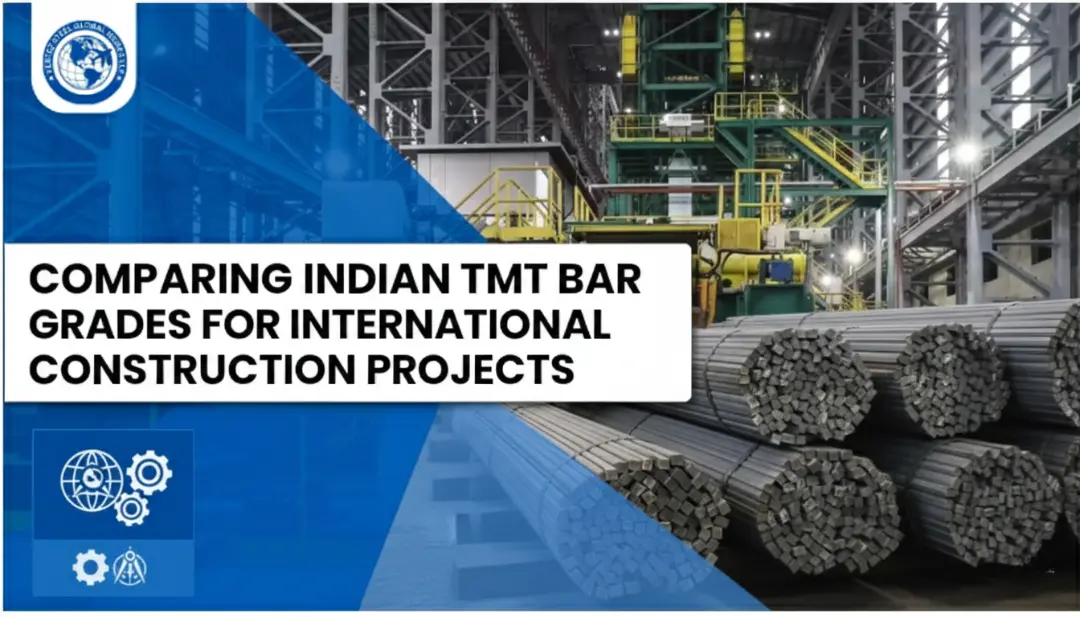
Comparing Indian TMT Bar Grades for International Construction Projects
Introduction
Global infrastructure development across Asia, Africa, the Middle East, and Europe continues to increase demand for high-quality reinforcement steel. Indian manufacturers have become trusted suppliers by delivering Thermo-Mechanically Treated (TMT) bars that meet international expectations for strength, durability, and cost efficiency.
For contractors, procurement teams, and developers managing cross-border projects, selecting the correct TMT bar grade—from Fe 415 to Fe 600—is a critical decision. The right grade directly influences structural safety, long-term performance, and overall project economics.
Experienced TMT bar exporters and bulk suppliers in India support global projects through scalable production, consistent quality, and export-ready documentation—ensuring reliable supply chains for large engineering works.
Understanding TMT Bars and Their Importance in Modern Construction
TMT bars are high-strength reinforcement bars produced through a thermo-mechanical treatment process involving rapid quenching and controlled cooling. This creates a hardened outer layer with a ductile inner core.
The result is a reinforcement material that offers
- High tensile strength
- Superior ductility
- Resistance to corrosion and fatigue
- Strong bonding with concrete
These properties make TMT bars essential for critical infrastructure where durability and structural stability are non-negotiable.
For international projects, sourcing from experienced bulk TMT bar suppliers ensures standardized dimensions, consistent mechanical properties, and traceable manufacturing processes.
Overview of the Indian TMT Bar Grading System
Indian TMT bars are classified under BIS specifications (IS 1786). The grade designation reflects the minimum yield strength in megapascals (MPa).
Common grades include:
- Fe 415
- Fe 500
- Fe 500D
- Fe 550
- Fe 550D
- Fe 600
Each grade provides a different balance between strength and ductility, allowing engineers to select reinforcement suited to specific load conditions and structural requirements.
Fe 415 Grade TMT Bars
Key Characteristics
- Yield strength: 415 MPa
- High flexibility
- Good weldability
Typical Applications
- Residential housing
- Low-rise construction
- Small infrastructure
Fe 415 is often selected where ease of bending and seismic flexibility are priorities. However, many modern projects now prefer higher grades to optimize steel consumption.
Fe 500 Grade TMT Bars
Key Characteristics
- Yield strength: 500 MPa
- Balanced strength and ductility
- Cost-efficient reinforcement
Typical Applications
- Commercial buildings
- High-rise structures
- Bridges
- Industrial projects
Fe 500 remains the most widely specified grade for international construction. Its higher strength reduces total steel usage while maintaining structural reliability, making it a preferred export grade among leading Indian suppliers.
Fe 500D Grade TMT Bars
Key Characteristics
- Yield strength: 500 MPa
- Enhanced ductility
- Improved performance under dynamic loads
Typical Applications
- Earthquake-resistant structures
- Bridges and flyovers
- Major infrastructure
The additional elongation in Fe 500D allows structures to absorb stress without sudden failure—an important advantage in seismic regions.
Fe 550 and Fe 550D Grades
Key Characteristics
- Yield strength: 550 MPa
- Higher load-bearing capacity
- Fe 550D provides additional ductility
Typical Applications
- High-rise construction
- Heavy industrial projects
- Large infrastructure
These grades help reduce reinforcement congestion by achieving required strength with fewer bars. Fe 550D is particularly effective where both strength and flexibility are required.
Fe 600 Grade TMT Bars
Key Characteristics
- Yield strength: 600 MPa
- Extremely high load-bearing capacity
Typical Applications
- Mega infrastructure
- Specialized engineering structures
Fe 600 enables significant reductions in steel volume, though careful structural design is required to manage ductility considerations.
Key Differences Between Indian TMT Bar Grades
Strength vs. Ductility
- Lower grades (Fe 415): Greater flexibility
- Mid-range grades (Fe 500, Fe 500D): Balanced performance
- Higher grades (Fe 550, Fe 600): Maximum strength
Application Suitability
- Residential: Fe 415
- General construction: Fe 500
- Seismic zones: Fe 500D / Fe 550D
- Heavy infrastructure: Fe 550 / Fe 600
Cost Efficiency
Higher grades may have higher per-ton pricing but can reduce total steel consumption, improving overall project economics.
Factors International Buyers Should Consider
Project Design Requirements
Structural engineers determine grade selection based on load calculations, safety margins, and compliance requirements.
Environmental Exposure
Coastal or humid environments require reinforcement with enhanced corrosion resistance.
Standards Compliance
Working with experienced exporters—such as Vertez Steel Global—helps ensure proper documentation, traceability, and alignment with international testing protocols.
Supply Consistency
Large projects require dependable delivery schedules. Established bulk suppliers provide uniform sizing, reliable timelines, and predictable quality across shipments.
Quality Assurance and Testing
Before importing TMT bars, buyers should verify:
- Chemical composition
- Yield and tensile strength
- Elongation values
- Bend and rebend test results
Mill test certificates and third-party inspections reduce procurement risk and confirm compliance with engineering specifications.
Logistics and Packaging for International Shipment
Efficient logistics are essential for large infrastructure projects. Reliable exporters typically provide:
- Bundled and tagged bars
- Protective coatings when required
- Clear traceability labeling
Export-focused partners such as Vertez Steel Global coordinate documentation, packaging, and shipment planning to minimize transit risks.
How Bulk Procurement Improves Project Efficiency
Bulk purchasing offers measurable advantages:
- Volume-based cost savings
- Reduced procurement delays
- Consistent material performance
Many international contractors partner with established bulk TMT bar suppliers to stabilize supply chains and maintain construction schedules.
Future Trends in Global Reinforcement Steel Usage
As infrastructure projects grow more complex, demand is increasing for higher-strength grades that enable:
- Optimized steel consumption
- Improved seismic performance
- Longer service life
Indian manufacturers continue upgrading production technologies to meet evolving global engineering standards.
Conclusion
Selecting the appropriate TMT bar grade is fundamental to structural safety, durability, and cost control in international construction projects.
Fe 500 remains the most versatile and widely used grade, while ductile variants such as Fe 500D and Fe 550D are preferred for seismic performance. Higher-strength grades like Fe 550 and Fe 600 support heavy infrastructure where maximum load capacity is required.
By partnering with reliable exporters and experienced bulk suppliers, international buyers can secure consistent quality, complete documentation, and dependable logistics.
Vertez Steel Global connects global procurement teams with trusted Indian manufacturers, offering competitive pricing, verified quality, and end-to-end export support. With a focus on transparency and reliability, Vertez helps streamline bulk sourcing and strengthen international project supply chains.
If you are planning a large-scale construction project or expanding your supplier network, Vertez Steel Global can provide customized sourcing solutions designed to support efficient execution and long-term growth.
FAQs
1. How do Indian TMT bars compare with international reinforcement standards?
Indian TMT bars manufactured under IS 1786 are widely accepted in global markets and often meet or align with ASTM, BS, or EN performance requirements. Reputed exporters provide test reports and certifications that help engineers verify equivalency during project approvals.
2. What does the “D” designation mean in TMT bar grades?
The “D” indicates higher ductility, meaning improved elongation and flexibility under stress. Grades like Fe 500D and Fe 550D are designed to absorb deformation without sudden fracture, making them suitable for seismic zones and dynamic load conditions.
3. Can higher-grade TMT bars reduce overall steel consumption?
Yes. Higher yield strength allows engineers to achieve required structural capacity with fewer or smaller-diameter bars. Although the per-ton price may be higher, optimized design often reduces total steel quantity, improving cost efficiency and reducing reinforcement congestion.
4. Are Indian TMT bars suitable for coastal or corrosive environments?
Many Indian manufacturers produce TMT bars with controlled chemical composition and corrosion-resistant properties. When combined with proper concrete cover and protective practices, these bars perform well in coastal, humid, or chemically exposed construction environments.
5. What documentation should exporters provide with TMT bar shipments?
Standard export documentation typically includes mill test certificates, chemical and mechanical test reports, heat numbers for traceability, packing lists, and compliance certificates. Third-party inspection reports may also be provided to meet international procurement and regulatory requirements.
6. Which TMT bar grades are recommended for high-rise construction?
Grades such as Fe 500, Fe 500D, or Fe 550 are commonly specified for high-rise buildings. They offer strong load-bearing capacity while maintaining adequate ductility, allowing engineers to manage reinforcement density and ensure structural safety under vertical and lateral loads.
7. How is the quality of TMT bars verified before use on-site?
Quality verification includes reviewing mill certificates, checking dimensions and markings, and conducting tests such as tensile strength, elongation, bend, and rebend. Independent laboratory or third-party inspections are often used to confirm compliance with project specifications.
8. Why is consistent supply important for large infrastructure projects?
Consistent supply ensures uniform mechanical properties across construction phases, preventing variations that could affect structural performance. Reliable delivery schedules also reduce downtime, simplify inventory planning, and help contractors maintain project timelines and cost control.