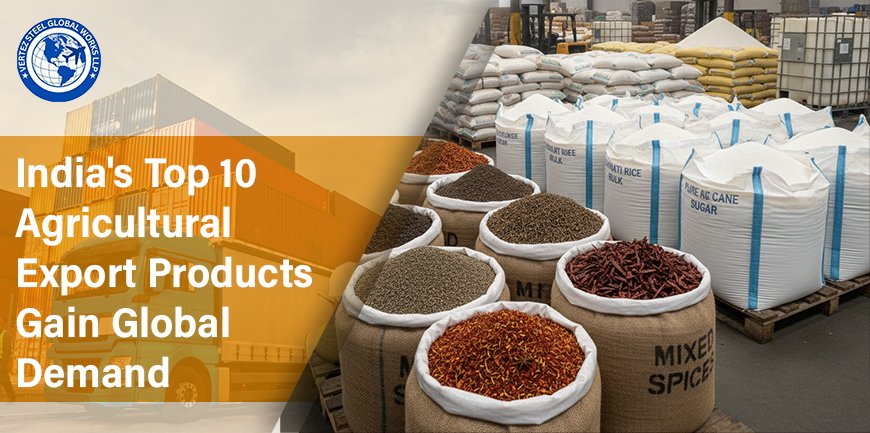
India’s Top 10 Agricultural Export Products Gain Global Demand
1. Introduction: India’s Agricultural Export Landscape in 2025
India continues to cement its place as one of the world’s largest agricultural exporters, with agri exports crossing USD 53 billion in FY 2025, marking a 6.8% CAGR since 2020. From basmati rice to spices and marine products, Indian farmers and exporters are powering a global supply network that feeds and fuels multiple industries.
According to India export data 2025, major destinations include the Middle East, USA, China, and the EU, with growing traction in Africa and ASEAN markets. Schemes under APEDA, Make in India, and the Agri-Export Policy have streamlined processes, incentivizing exporters and promoting traceability.
This article breaks down the top 10 products exported from India and what’s fueling their global demand in the modern trade era.
2. India Export Products List: Agricultural Strength Behind Global Demand
India’s export portfolio is diverse—ranging from cereals, pulses, and spices to fruits, vegetables, and processed foods. Together, these contribute nearly 12% to total merchandise exports.
The India export products list reveals that the agricultural economy benefits not just from vast production capacity but also from its competitive pricing and climate diversity.
Top importers like the UAE, Saudi Arabia, USA, Netherlands, and China rely on Indian produce for both bulk and specialty needs.
3. Top 10 Products Exported from India (Agricultural Sector)
3.1. Basmati Rice – India’s Global Signature Grain
India exported over 4.5 million tonnes of basmati rice in 2025, valued at around USD 4.7 billion. Its long grain, rich aroma, and GI-tagged varieties from Haryana and Punjab make it unmatched.
While Pakistan remains a close competitor, data shows India retained over 70% of the global basmati share in FY 2025.
Key Markets: Iran, Saudi Arabia, UAE, USA.
3.2. Non-Basmati Rice – India’s Hidden Export Giant
Often overlooked, non-basmati rice clocked USD 6.2 billion in exports. Government incentives and global demand for parboiled and broken rice have boosted this segment.
Top Destinations: Benin, Bangladesh, Nepal, and Senegal.
3.3. Spices – The Aromatic Backbone of Indian Trade
India commands nearly 75% of the world’s spice exports, led by turmeric, chilli, cumin, coriander, and cardamom. Andhra dominates in red chillies, Gujarat in cumin, and Kerala in cardamom.
Concerns about pesticide levels have been addressed with quality certifications and APEDA monitoring, strengthening India’s purity assurance.
3.4. Tea – India’s Heritage Crop
From Assam and Darjeeling to Nilgiri, India exports nearly USD 850 million worth of tea annually.
Premium GI-tagged teas fetch high margins in Japan, the UK, and the US. Climate challenges are real, but adaptive cultivation is maintaining yield quality.
3.5. Coffee – From Karnataka to the World
India’s coffee exports—dominated by Robusta (70%) and Arabica (30%)—crossed USD 1.1 billion in 2025. Specialty Indian coffees are gaining fame in Europe for their low acidity and earthy tones.
3.6. Marine Products – A Silent Billion-Dollar Segment
India’s top-earning agri-export segment, marine exports reached USD 8 billion in 2025, led by frozen shrimp.
The US, China, and Vietnam remain the biggest buyers. Sustainability certifications from MPEDA have helped Indian exporters secure long-term contracts.
3.7. Fresh Fruits – Mangoes, Grapes & Pomegranates
India’s fruit exports touched USD 1.5 billion, with Alphonso mangoes, Thompson grapes, and Bhagwa pomegranates leading.
Cold-chain innovations and packaging improvements are reducing spoilage and boosting profitability.
3.8. Vegetables – Onions, Potatoes & Okra
Despite frequent export restrictions to stabilize domestic supply, India still exported USD 900 million worth of vegetables.
Onions to the Middle East and okra to the US are leading segments.
3.9. Oilseeds and Pulses – Groundnut, Sesame & Chickpeas
Together, oilseeds and pulses contribute nearly USD 1.2 billion to India’s export revenue.
Rising global demand for plant-based protein positions India as a key player.
3.10. Processed Agro Products – Ready-to-Eat & Packaged Food
The fastest-growing export category with a CAGR of 10.5%, driven by ethnic food demand abroad.
NRIs, supermarkets, and health-conscious consumers worldwide are turning to Indian packaged foods for both affordability and taste.
4. Most Profitable Export Products from India: Where the Margins Lie
The most profitable export products from India are those balancing volume and value — namely marine products, spices, and basmati rice.
Marine goods lead in revenue, while basmati and spices outperform in profit-to-volume ratios. Efficient logistics, stable pricing, and consistent demand sustain their margins.
5. India Export Data and Market Trends (2020–2025)
Between 2020 and 2025, India’s agricultural export CAGR stood at 6–7%, with spikes in processed foods and marine categories.
Trends shaping exports today include traceability tech, sustainable sourcing, and digital B2B trade platforms.
Exporters are increasingly visible on online export websites, connecting with verified global buyers — a crucial step toward scaling presence.
Keywords: India export data, best export website India
6. Challenges in India’s Agri Export Sector
Despite success, hurdles persist:
- Quality compliance with EU and FDA standards
- Packaging and logistics inefficiencies for perishables
- Currency volatility and freight costs affecting competitiveness
- Export bans triggered by domestic inflation pressure
These underline the need for smarter systems and diversified supply chains.
7. Technology and Sustainability Shaping the Future
Digitization is transforming exports. Blockchain and QR-based traceability allow global buyers to track produce back to farms.
Eco-friendly packaging, solar-driven cold storage, and carbon-neutral shipping models are increasingly adopted.
The Indian government’s Agriculture Infrastructure Fund supports exporters embracing these sustainable upgrades.
8. Choosing the Best Export Website India: How Digital Platforms Help Exporters
For new exporters, listing products on trusted B2B export websites helps bridge the visibility gap. Verified platforms ensure buyer authentication, real-time pricing, and secure trade assurance.
These sites are now vital for expanding India’s agri-export reach beyond traditional offline routes.
9. Conclusion: India’s Path Toward Becoming a Global Agricultural Powerhouse
From rice and spices to marine products and processed foods, India’s agricultural sector has evolved into a robust global force.
Strong export data, government support, and digital adoption ensure that India remains central to global food supply in the coming decade.
Vertez Steel Global, as a trusted name in export logistics and sourcing, echoes this growth story — enabling partners worldwide to access India’s finest agri products with efficiency and transparency.
As the world leans toward sustainability and smarter trade, India’s farmers and exporters are not just participating in the global market — they’re defining its future.